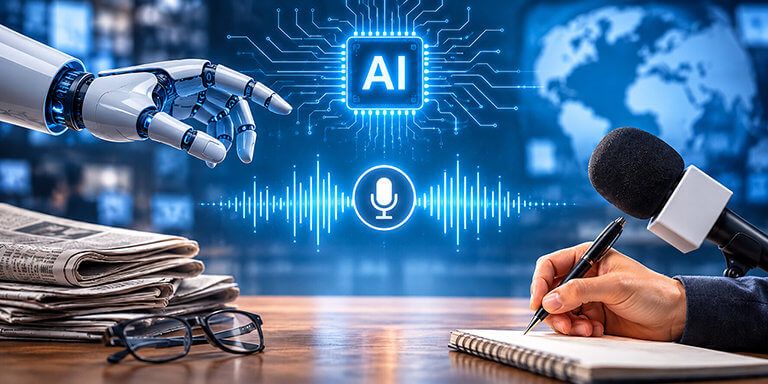
AI transcription turns hours of typing into minutes, but AI transcription ethics starts from one fact: It does not take any responsibility away from the journalist. Machine text cannot support a story until a journalist and an editor have been through it. If something goes wrong, the software is not to blame; the journalist and the outlet are.
Let me answer the question of telling readers up front: You do not need to note next to every quote that AI helped transcribe it. But an outlet should state somewhere public which tools it uses and how it checks the text. If you publish a full transcript, or had AI translate or summarise what was said, say so in the piece itself. Below I explain why I think so and the ethical problems that come with AI-assisted transcription.
Machine text is unverified material
Automatic transcription looks like a clever tape recorder, but it is not one. A recorder keeps the sound as it was. A transcription model runs calculations on the sound and predicts text from it. The difference matters because even a wrong prediction reads smoothly and convincingly. The error does not show itself to the reader.
Professional codes say the same thing. In Turkey, where I work, article 18 of the Press Council's principles calls AI a support for the media that cannot replace it. It leaves final responsibility with the journalist, asks that readers be told clearly when and how information from AI was used, and holds AI-assisted content to the same verification standards as everything else. Article 6 already says that a story whose accuracy is in doubt cannot be published.
The Turkish Journalists' Association's declaration of rights and responsibilities is the only national code there with a section of its own on AI. It asks that all AI-assisted content be produced under editors' final control, that the program used be named in the content, and that the prompts given to it be kept.
International codes agree. The IFJ's recommendations on AI say that output without human oversight cannot count as journalism and that no step back in accuracy is acceptable. The AP treats generative AI output as "unvetted source material", the BBC asks for active human oversight, and the Paris Charter holds outlets accountable for everything they publish. The provision the Cyprus Media Ethics Committee added to its code in 2025 also refuses to treat AI as a primary source and requires human oversight before publication.
The AP wrote its sentence about generative tools and does not name speech recognition. Treating transcription the same way is still the safest course. Check every quote that goes into print against the audio. Editors are part of the chain too: The journalist checks the text against the sound, and the editor asks whether that was done.
One more thing: The transcription equivalent of the Turkish declaration's rule on keeping prompts is keeping the original recording. It is the only basis both for checking and for answering any challenge later.
The sentence nobody said
AI transcription has a problem called hallucination: Words that are not in the audio appear in the text. That is more dangerous than a misheard word, because the result is a clean sentence nobody ever said. You do not stumble over it as you read, so you do not notice it.
The best-known study is Careless Whisper by Koenecke and colleagues, published at ACM FAccT 2024. In spring 2023 the researchers ran 13,140 English audio segments from AphasiaBank through the Whisper API. Some came from speakers with aphasia, some from a control group; all were sentence-length clips.
The result: On average, 1.4 percent of the transcriptions contained phrases that were not in the audio. Of those, 38 percent carried harmful content such as violence, invented relationships or false authority. Hallucinations were more frequent for speakers with aphasia (1.7 percent against 1.2 percent) and rose in recordings with long silences.
Two further details matter. First, the same problem segments were run through Google, Amazon, Microsoft, AssemblyAI and RevAI, and none of them invented anything similar. Second, in a December test after the updates of late November 2023, 12 of the 187 problem segments still produced hallucinations. The problem is shrinking, but it has not gone.
Do not read too much into these figures either. The study used English, sentence-length clips, many of them from people with a speech disorder, and one service at one point in time. It gives no rate for other languages, long interviews or today's models. What is certain: The problem is real, it shows up above all in silence, and you cannot always spot it by reading the text.
Alongside hallucinations come more ordinary errors: similar-sounding words, misspelled names, mixed-up figures, a lost negative. "We did" and "we didn't" are one small sound apart, and in Turkish a single suffix can turn a sentence's meaning around. Check those in the audio, not on the page.
The line between transcript and summary
Everything here is about writing speech down. Asking AI to summarise a conversation, or to pull quotes from it, is a different job and a far riskier one. A language model can easily produce a sentence that sounds said and was not.
There was a real case recently. In 2026 Ars Technica retracted a story containing quotes generated by an AI tool that the source had never said. It was not an editor who noticed, but the person quoted. Press Gazette keeps a list of similar cases, and it keeps growing.
The rule is simple: Every word inside quotation marks comes from audio the journalist heard. A summary, or a chatbot's "they said this", has no place inside them. The IFJ Global Charter of Ethics for Journalists says the same: Journalists report only facts whose origin they know (article 3), and distorting facts is a serious professional fault (article 10).
The rule holds for reported speech as well. Paraphrasing a remark that was never checked against the audio does not fix the error; the words are still attributed to that person.
Consent first, then the recording
Transcription starts with a recording, so how the recording was made is part of its ethical limits. Here the codes are quite clear.
Article 10 of Turkey's Press Council principles is short and firm: No image or sound may be recorded or published without the source's permission. The Turkish Journalists' Association's declaration accepts a recording made without consent only when there is a direct public interest and it is certain the information cannot be had any other way; it rules out deceptive methods such as hiding one's identity altogether.
Article 4 of the IFJ Global Charter likewise asks journalists to use only fair methods and always to say that they are journalists. It accepts covert recording only where the public interest outweighs everything else and the information cannot be gathered otherwise. Article 26 of the Northern Cyprus Media Ethics Board's principles follows the same line: Unless there is an overriding public interest, journalists should avoid hidden cameras, recording without consent, concealed identities and similar methods.
So the rule is: Without your source's consent, do not use the recording. And do not weigh the overriding public interest exception alone; weigh it with your editor.
Consent should also cover where the recording will be processed. Article 8 of the IFJ charter asks that interviewees be told the conversation may be published and that particular care be taken with inexperienced or vulnerable people. Someone who agrees to be recorded has not thereby agreed to their voice being sent to a third-party cloud service. If you will process the audio in the cloud, tell your source. For a sensitive conversation, do not use the cloud at all.
Where your source's voice and words go
The ethics of transcription go beyond accuracy. Protecting sources is a duty in most codes, and in Turkey it is law: Article 12 of the Press Law says publishers, editors-in-chief and authors cannot be forced to reveal their sources, and the Press Council principles (article 10) and the Journalists' Association declaration (D-5) protect source confidentiality as well.
When you send a recording or a transcript to someone else's server, you put that protection at risk. A provider that keeps audio or text on its servers can expose a journalist's source through a data breach or a legal demand it is forced to meet. Keep that in mind when you choose a tool.
International bodies are cautious too. The Swiss Press Council asks that confidential or personal data not be entered into AI programs when there is no control over how the data will be used later. France Médias Monde's guide goes further and likens giving information to an AI tool to publishing it. The Freedom of the Press Foundation recommends tools that run on your own device, not on third-party servers, for sensitive work.
Do not put identifying names or details in speaker names or the title. Remember that what was said can give a source away too. Export the text and delete it when you are done.
For a conversation that could put your source's life at risk, using no internet-connected tool at all is a legitimate decision. The recording on your phone and the file on your computer need the same care.
Whatever tool you choose, ask first: Who receives the audio? Is it kept, and is it used for training? Where does the text live, and who can open it? How long does deleted data stay in backups? What happens if the provider receives a legal demand?
Ask a few questions when choosing a tool, too. The Paris Charter asks that AI systems used in journalism be assessed independently beforehand. The Council of Europe's procurement checklist suggests asking about the model, training data, data ownership, storage and liability before buying. Which model does it use? What error rate was measured in your language, and how? How was it tested for hallucinations? Where is data kept, and when is it deleted? Keep any tool that cannot answer these out of the newsroom.
Cleaning up the text is a decision too
Most transcription tools remove filler sounds—such as “um,” “uh,” and “hmm”—as well as repetitions and incomplete words to make the text more readable; consequently, the text is not a verbatim record. While this certainly makes it easier to read, it is not a neutral process.
A pause before an answer can be news. A long silence before replying to a question about corruption, a self-correction, a stammer or a laugh changes how a quote reads. None of these show in cleaned-up text.
Whether to present speech cleaned up or word for word is an editorial decision, and it belongs to the journalist. The Turkish Journalists' Association's declaration asks journalists to report facts without distortion and not to alter texts. That decision should not be left to a tool's default setting.
In practice, I suggest this: For sensitive quotes and answers to contested questions, go back to the raw recording. If a pause or a self-correction carries meaning, report it in the story. If you publish a full transcript, either turn hesitation removal off or say that the text was cleaned up.
Should you tell the reader?
There is no easy answer. Let me set out my view and what it rests on.
The Turkish codes favour disclosure. Article 18 of the Press Council principles recognises the public's right to know when and how information from AI was used and asks that readers be told clearly. The Journalists' Association declaration asks that the program used be named in the content. In the US surveys reported by The Journalist's Resource, most readers expect disclosure too.
But these codes do not mention transcription, and they make no exception for it either. The declaration's provision is built on "production", while article 18 speaks of "information obtained from AI". Does transcription fall under them? Frankly, it is open to interpretation.
International texts set the threshold in different places. The IFJ wants work that is wholly or largely AI-made to be labelled. The Paris Charter asks for disclosure of any use with a significant effect on production or distribution, and for a public record of the systems used. France Médias Monde lists transcription among the uses it allows freely and leaves it off its labelling list, while asking for full transparency towards the public. The EU AI Act exempts text that has gone through human review and for which editorial responsibility is taken from its disclosure duty.
My view is disclosure in tiers. Transcription is a tool that makes writing easier and should not change the substance of a story. Once checked against the audio, a quote used in a story is the speaker's own words. So there is no need to write "transcribed with AI" next to every quote.
But readers cannot see whether the checking was done. The best answer to article 18's "when and how", I think, is this: An outlet states on a public page which tools it uses for transcription and how it verifies the text. That also matches the public record the Paris Charter proposes.
Disclosure in the piece itself is needed in four cases. If the story is a transcript, meaning you publish the full text of a conversation, say that it was produced automatically, that it was checked, and whether it was cleaned up; readers cannot tell how far it was checked. If AI translated, say so too, because translation changes the words themselves. If AI summarised the text, wrote the story or picked the quotes, that is a direct contribution to the content; disclose it as well. Finally, if your outlet's policy asks for disclosure, follow it. An outlet that reads article 18 as covering transcription has a fair case.
Who answers for the error?
"The software got it wrong" is no defence. If a published quote is wrong, the journalist corrects it and apologises. They chose the tool, did the checking and published. The Paris Charter places responsibility on the outlet as well: It answers for everything it publishes and assigns responsibility for AI use to named people in advance.
When an error happens, correct it openly. The Turkish Journalists' Association asks that every error be corrected as soon as possible and, online, that the reason for and date of the update be explained to readers in the same piece. The IFJ charter requires corrections to be quick, clear, complete and transparent. Talk about how the error happened inside the newsroom too; that conversation often prevents the next one.
Toolmakers carry responsibility as well. The Council of Europe's guidelines on AI in journalism expect technology providers to respect editorial independence and to support news organisations. A transcription tool cannot make errors go away; but stating its limits openly and making checking easier is its job. I write this piece partly out of that responsibility.
Professional codes need to catch up with AI
Most of the debates in this piece come from one gap: Professional codes do not deal with the everyday uses of AI one by one. Article 18 of Turkey's Press Council principles is a single paragraph. The Journalists' Association declaration's section on AI is three paragraphs long and built on "production". The IFJ Global Charter, adopted in 2019, does not mention AI at all.
Yet the Swiss Press Council updated its code in 2024 and the Cyprus Media Ethics Committee in 2025. Codes elsewhere need to take transcription, text clean-up, translation, summarising and cloud processing one at a time as well. Rules such as checking quotes against the audio, keeping the original recording, telling sources where their voice will be processed, and not using tools that do not disclose their model, error rate or data policy belong in a professional code now, not in a blog post. A clause accepting that altering a voice no longer protects identity is needed too. And these codes should state that they will be reviewed at set intervals, because technology changes faster than codes do.
Press councils, journalists' associations and unions can lead the way. The Council of Europe guidelines ask self-regulatory codes to set out a transparent vision on AI. Aidan White, founder of the Ethical Journalism Network, also calls for editorial codes to be revised.
Until those updates come, guides like this one fill the gap. Remember that some of them, just like this one, are published on the websites of people who sell tools.
Checklist before publishing
| Question | If not |
|---|---|
| Was every direct quote heard in the audio? | Listen; if you cannot, do not use the quote |
| Were figures, dates, names and negatives checked? | Do not publish |
| Is each remark attributed to the right person? | Check the video or audio |
| Did you go back to the raw recording for sensitive quotes? | Do so, and report pauses that carry meaning |
| Do you still have the original recording? | Verify the quote from another source |
| Does the text come from a transcript, not a summary or chatbot? | Go back to the source |
| Did the source agree to the recording? | Do not use it; weigh the public interest with your editor |
| Does the source know which tool will process their voice, and where? | Tell them; do not use the cloud for a sensitive conversation |
| Are your source's name and voice somewhere you trust? | Change the tool or setting |
| Does your editor know the check was done? | Tell them |
| If there is a full transcript, AI translation or summary, were readers told? | Tell them |
| Are your outlet's transcription tools and checking method public? | Publish them |
I read the texts cited here on 7 November 2026; check their current versions at the source.
Sources
Codes of ethics and guidelines
- Basın Meslek İlkeleri — Press Council of Turkey (in Turkish)
- Türkiye Gazetecileri Hak ve Sorumluluk Bildirgesi — Turkish Journalists' Association (in Turkish)
- Global Charter of Ethics for Journalists — International Federation of Journalists
- IFJ Recommendations on the use of artificial intelligence — International Federation of Journalists
- Gazetecilik Meslek İlkeleri — Northern Cyprus Media Ethics Board (in Turkish)
- AI use by journalists addressed in new guidelines — the Cyprus Media Ethics Committee's AI provision, Sigmalive
- AI in Journalism — Swiss Press Council
- Paris Charter on AI and Journalism — RSF and 16 partner organisations
- Guidelines on the Responsible Implementation of AI Systems in Journalism — summary of the Council of Europe guidelines
- Artificial Intelligence: Another layer of crisis for journalism and democracy — Aidan White, Ethical Journalism Network
- Standards around generative AI — Associated Press
- Use of Artificial Intelligence — BBC Editorial Guidelines
- Guide des bonnes pratiques de l'utilisation de l'IA — France Médias Monde (in French)
Legislation
- Basın Kanunu No. 5187 — Turkish Press Law, text from the Union of Turkish Bar Associations (in Turkish)
- EU AI Act, Article 50
Research and reporting
- Careless Whisper: Speech-to-Text Hallucination Harms — Koenecke et al., ACM FAccT 2024
- Ars Technica and AI-fabricated quotes — Futurism
- AI journalism mistakes — Press Gazette
- What audiences want disclosed about AI use in news — The Journalist's Resource
- Should I be concerned about AI transcription tools? — Freedom of the Press Foundation